
What about aluminum welding?
Anyone who welds aluminium knows that it has never been an obvious material. The heat drains quickly, the weld pool reacts differently and what still feels quite stable with steel requires that little bit of extra control with aluminium. In many workshops, this is simply accepted as “that’s just the way aluminium is”. Yet it doesn’t have to stay that way. This is where laser technology once again makes a clear difference.
The main reason why aluminum with laser often gives better and tighter results is in the way heat is introduced. Aluminium has a high thermal conductivity and dissipates energy quickly. In classic welding processes, this means that you have to introduce more heat to get a stable weld pool. This heat then spreads over a larger area, causing the entire workpiece to heat up faster and increasing the risk of deformation.
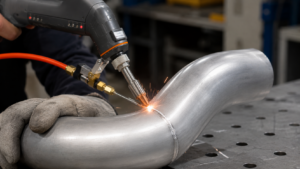
This is done differently with laser welding. The laser introduces energy in a much more targeted way, giving you a high local energy density without heating the entire workpiece unnecessarily. This does not mean that the heat only remains local, even with laser the material heats up further, but the total heat input remains significantly lower and better controlled. And it is precisely that difference that is important with aluminum. Less total heat input means that you build up less tension in the material. As a result, you have less chance of warping and the workpiece remains more stable during and after welding.
That does not mean that aluminium suddenly becomes an easy material. It remains more sensitive than steel and still requires attention to preparation, purity and settings. But because the energy is introduced in such a targeted and controllable way, you can control the process much more accurately.
Especially with thin materials and visible work, you can clearly see that difference. Where aluminium deforms faster in traditional welding processes or reacts to small differences, laser allows for more constant work. The weld remains tight, the deformation is limited and the end result looks more uniform.
Of course, that doesn’t mean that everything goes by itself. Material type, fit and settings also continue to play a major role in laser welding. Aluminium still requires the right approach and the right choice of parameters. But compared to classic welding techniques, the thermal impact is easier to control.
In short: aluminium is not an obvious material for welding. But thanks to the focused energy input and lower total heat input of laser technology, you can achieve nicer, more stable results, with less distortion and a more controllable process. And that is precisely where the difference lies in practice.