
Is a laser weld seam as strong as a classic MIG & TIG?
When you see a laser weld for the first time, you often doubt its strength. The weld is narrower, finer and lacks the typical “build-up” that you are used to with MIG or TIG. But the question is not what a weld looks like, but how its strength is effectively determined.
In classic welding processes such as MIG and TIG, the strength of the weld is largely determined by the a-value (throat height). This a-value determines the effective cross-section of the weld, and thus how much force the joint can absorb.
In addition, other factors also play a role:
- Penetration into the base material
- Quality of the fusion
- Heat input and influence on the material
- Presence of defects or porosity
With MIG and TIG, a large part of that strength is obtained from the visible structure of the weld. The weld is wider on the material and thus creates a larger effective throat section (a-value).
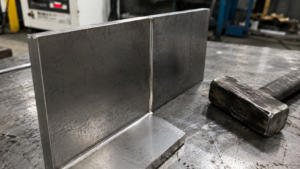
This works fundamentally differently with laser welding. The laser applies its energy in an extremely concentrated way, giving you a much deeper penetration in relation to the width of the weld. The weld is narrower, but often penetrates deeper into the material. This means that the effective “working cross-section” of the weld is not visible from the outside. Where a classic weld gets its strength from width and structure, a laser weld gets its strength from depth and internal structure.
As a result, despite its smaller appearance, a laser weld can achieve a similar effective cross-section in many applications, and thus also a similar strength. In some cases, it can be higher, but it always depends on factors such as penetration, joint design and settings. It is therefore not a general rule, but always application-specific.
In addition, laser welding has an additional advantage. Due to the more targeted and generally lower total heat input, the heat-affected zone (HAZ) usually remains smaller. This means that the mechanical properties of the surrounding material can be better preserved. In classical processes, this zone can be larger, which can lead to local changes or weakening in the material. Laser limits that effect, but does not completely eliminate it.
Does that mean laser welding is always stronger? Not necessarily. As with MIG or TIG, the final strength depends on the application:
- At thin to medium thicknesses, laser can achieve very strong, homogeneous welds.
- For thicker materials or applications where a lot of filler material is required, MIG and TIG often remain more suitable.
The most important conclusion is therefore that the comparison between laser and classical techniques is not in “more or less material”, but in how the strength is built up.
In short:
A laser weld is absolutely no less sturdy, it just works according to a different logic.