
Deformation in laser welding
Those who suffer classically know the problem. You lay a weld, and suddenly the material warps. Corners give way, sheet metal bulges, and what just fitted nicely suddenly requires extra correction. Deformation is so common in many workshops that it is almost taken for granted. Yet it doesn’t have to be that way. This is where laser technology makes a striking difference.
The main reason why materials deform much less in laser welding is in the way heat is introduced.
In traditional welding processes, a relatively wide zone of the material is heated. This causes the metal to expand over a larger surface area. When it cools down again, it also shrinks unevenly. And it is precisely that voltage difference that causes distortion. This is completely different with laser welding. The laser beam introduces heat in an extremely targeted and concentrated way. Only the zone that is really needed for welding is heated. The heat spreads less to the area around the weld. As a result, the heat-affected zone remains smaller, and the material has much less chance of pulling, bulging or going out of shape.
This is not a small detail, but one of the biggest practical advantages of laser technology. After all, less distortion means much more than just a better result. It also means that parts remain dimensionally stable, that fit remains more correct, and that less time is lost on straightening, grinding or other post-processing. What at first glance seems like a technical advantage therefore very quickly becomes a gain in speed, quality and efficiency.
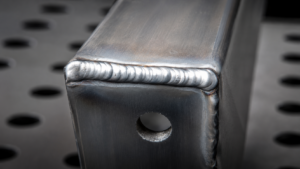
This difference is particularly noticeable with thin materials, fine constructions and visible work. Where traditional methods introduce too much heat more quickly, laser allows you to work much more precisely. The weld remains controlled, the impact on the surrounding material is limited, and the end result looks sleeker. This makes laser welding particularly interesting for applications where finish, aesthetics and accuracy play an important role.
This is also a great advantage in production environments. Less distortion ensures more predictability in the process. Parts remain more consistent, rework decreases and the risk of deviations is reduced. Especially when speed and reproducibility are important, this helps to make the entire workflow more stable.
Of course, that does not mean that distortion is completely excluded. Material type, thickness, fit and settings also continue to play an important role in laser welding. But compared to classic welding techniques, the thermal impact is much smaller, and this is precisely why deformation is drastically reduced.