
Laser welding vs TIG welding: what are the real differences in practice?
Anyone who has been welding for a long time knows TIG as the reference for quality. The process is controlled, reliable and produces beautiful welds. With the rise of laser welding, the comparison is therefore quickly made. But although both techniques are often placed in the same category, in practice they differ more than you might think at first glance.
The biggest difference is in the way heat is introduced. With TIG welding, you work with an electric arc that heats up a relatively wide zone. This requires control from the operator and ensures a weld pool that spreads more widely. In laser welding, that energy is extremely concentrated. The laser focuses on a very small surface, so that the heat is introduced in a much more targeted way.
You can see that immediately in the result. Laser welding produces a narrow, deep weld with very limited heat input. As a result, the deformation remains minimal and the weld looks tighter. TIG also provides a high-quality weld, but often requires more control and can provide a wider weld zone more quickly. So the difference is not only in quality, but especially in how that quality is achieved.
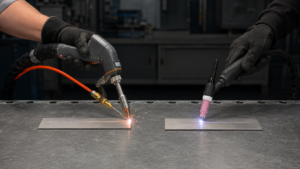
Speed also plays a clear role. Laser works faster, especially with repetitive or series work. Where TIG is a rather controlled and step-by-step process, laser allows a weld to be pulled through much faster without sacrificing consistency. This makes it particularly interesting in environments where lead time is important.
On the other hand, TIG is often more flexible in less ideal circumstances. Because the operator actively controls the process and can manually adjust filler material, TIG can better deal with variations in fit or material. Larger gaps or deviations can still be corrected during welding.
In laser welding, the emphasis is more on precision, which makes the fit more important. Large slits are less suitable, because the laser works with a smaller and more controlled weld pool. However, that does not mean that there is no margin at all. Small gaps or slight deviations can still be absorbed in practice, especially with the right settings and experience.
So the difference is not in “possible or not”, but rather in how much leeway you have. TIG offers more flexibility when preparation is less accurate, while laser welding is at its best when the fit is well controlled.
It also differs greatly in terms of use. TIG welding requires experience and a steady hand. The quality depends very much on the operator. Laser welding is more consistent in that regard. With the right parameters, you can achieve a repeatable result faster, even with different users. This makes the process more accessible and less dependent on individual skill.
Does that mean that one technique is better than the other? Not really. It depends entirely on the application. For fine work, thin to medium-thick materials, speed and clean finishing, laser welding has clear advantages. For customization, more tolerances or situations where flexibility is needed, TIG remains a very strong choice.
In practice, both techniques often complement each other. Those who only look at “which one is better” are missing the point. The real question is: what do you need for this specific piece of work? If you choose the right technique, you will get the most out of both worlds.