
What determines the quality of a laser weld?
Anyone who works with laser welding quickly notices that the quality of the weld does not come about overnight. There are a number of clear factors behind a tight and consistent result. Understanding where that quality comes from immediately makes it clear why the process works so well, but also where it could possibly go wrong.
In practice, it mainly comes down to two things: preparation and parameters.
A good weld does not start with the machine, but with the fit. The better the parts connect, the more stable the process is. In laser welding, large deviations are less desirable because the process works with a smaller and more controlled weld pool. However, that does not mean that there is no margin. Gaps or tolerances can certainly still be absorbed in practice, provided the right settings and experience. So it’s mainly about control, not absolute perfection.
In addition, the material plays an important role. Different metals react differently to laser energy. Think of reflection, heat conduction or existing coatings. Stainless steel, steel and aluminium can all be welded perfectly, but each requires its own approach. Understanding the properties of the material allows you to fine-tune the process better and work more consistently.
That brings us to the parameters. Correctly setting power, speed and focus is essential to achieve a quality weld. Does this mean that only experienced welders can work with laser welding? Absolutely not. One of the strengths of laser technology is that these parameters can be easily stored and repeated. Once the correct settings for an application have been determined, they can be reused without having to adjust each time.
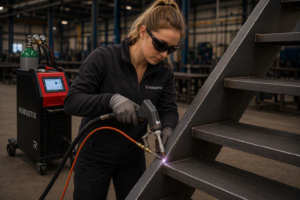
This ensures that even less experienced operators can achieve a very consistent result. The quality therefore becomes less dependent on the person who is loading, and more on the setup itself. In production environments, this is a big advantage: welds look the same every time, no matter who performs them.
Finally, the environment also plays a role. A stable setup, correct shielding and good gas protection all contribute to a reliable process. Because laser welding is so precise, small external influences can be noticed more quickly, but at the same time they are also easy to control with the right approach.
In short: the quality of a laser weld is no coincidence. It is the result of a combination of factors: good preparation, correct parameters, knowledge of materials and a stable working environment. When they come together, you get a weld that is not only technically strong, but also looks visually sleek, and that is exactly what makes the difference in practice.