
What is the difference between laser cleaning and sandblasting?
Anyone looking to remove rust, paint, coatings or other contaminants from a surface will quickly come across different cleaning methods. Sandblasting has been a well-known technique for many years, while laser cleaning offers a modern alternative that treats the surface in a completely different way. Both technologies can deliver excellent results, but they differ significantly in how they work, their impact on the material and their practical applications.
Two completely different technologies
With sandblasting, an abrasive medium is propelled against the surface at high pressure. The impact of these particles removes rust, paint and other contaminants. It is a powerful mechanical process that is particularly suitable when large surfaces need to be treated quickly or when a specific surface profile is required.
Laser cleaning works differently. Short, powerful laser pulses are directed at the surface to be cleaned. The laser settings are adjusted to the contamination and the underlying material, allowing the unwanted layer to be removed without the need for abrasive blasting media.
This fundamental difference means that both technologies have their own strengths.
Less impact on the underlying material
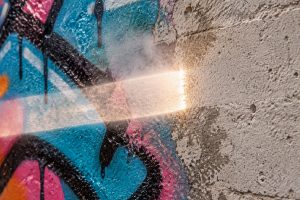
An important advantage of laser cleaning is the level of control over the cleaning process. The laser can be adjusted and applied very precisely. This makes it possible to remove rust, varnish, paint or certain coatings while preserving the base material as much as possible.
Sandblasting always creates a mechanical impact on the surface. This is not necessarily a disadvantage. For applications where the surface needs to be deliberately roughened, for example in preparation for a new coating, sandblasting can be an excellent choice.
When it is important to preserve the original structure, dimensions or details of a component as much as possible, laser cleaning often provides greater control.
No abrasive blasting media required
The way both technologies are used also differs considerably. Traditional blasting techniques require an abrasive medium that is consumed during the process. After cleaning, both the treated surface and often the surrounding area need to be cleaned.
With laser cleaning, no sand, grit or other abrasive blasting media is required. This means there is no used blasting material that needs to be collected and disposed of afterwards. The removed contamination itself does not simply disappear and, depending on the application, must be appropriately extracted or collected.
This makes laser cleaning particularly interesting for companies that want to treat components locally or integrate the cleaning process into a production environment.
Also suitable for highly localized cleaning
Not every component needs to be cleaned completely. Sometimes only a weld zone, contact surface, component or specific contaminated area needs to be treated.
This is one of the key strengths of laser cleaning. The laser can be applied very precisely, allowing only the required area to be treated. Examples include removing rust before welding, cleaning weld seams, removing paint from a specific area or cleaning tools and machine components.
Sandblasting remains an interesting option for larger surfaces, heavy contamination and situations where a uniform mechanical surface treatment is required.
Which technology is the best choice?
There is no single technology that is automatically better for every application. The right choice depends on the material, the contamination, the surface area, the desired end result and the subsequent production process.
Choose laser cleaning, for example, when:
- the base material needs to remain as intact as possible;
- only a specific area needs to be cleaned;
- you want to work without abrasive blasting media;
- precision and repeatability are important;
- cleaning needs to be integrated into an automated production process.
Sandblasting may be the better choice when large surfaces need to be treated, a mechanical surface profile is required or very heavy layers need to be removed.
Laser cleaning as a controlled alternative
Laser cleaning does not replace sandblasting in every situation. Instead, it offers a different way of cleaning: precise, targeted and without abrasive blasting media. For industrial companies, this can provide significant advantages, particularly for recurring cleaning tasks or when the process can be integrated into an existing production environment.
At Robustix, we therefore look beyond simply determining whether something can be cleaned with a laser. More importantly, we determine which settings and approach deliver the best result for the specific product and contamination. This makes it possible to assess in advance whether laser cleaning is an effective alternative for a particular application.